Research pins down skills that make a good music therapist
LAWRENCE — To be their best at serving all types of clients, music therapists must know something about and be able to play many different types of music. Far more important than their instrumental virtuosity is their musical flexibility, responsiveness and intent to help clients, according to University of Kansas researchers.
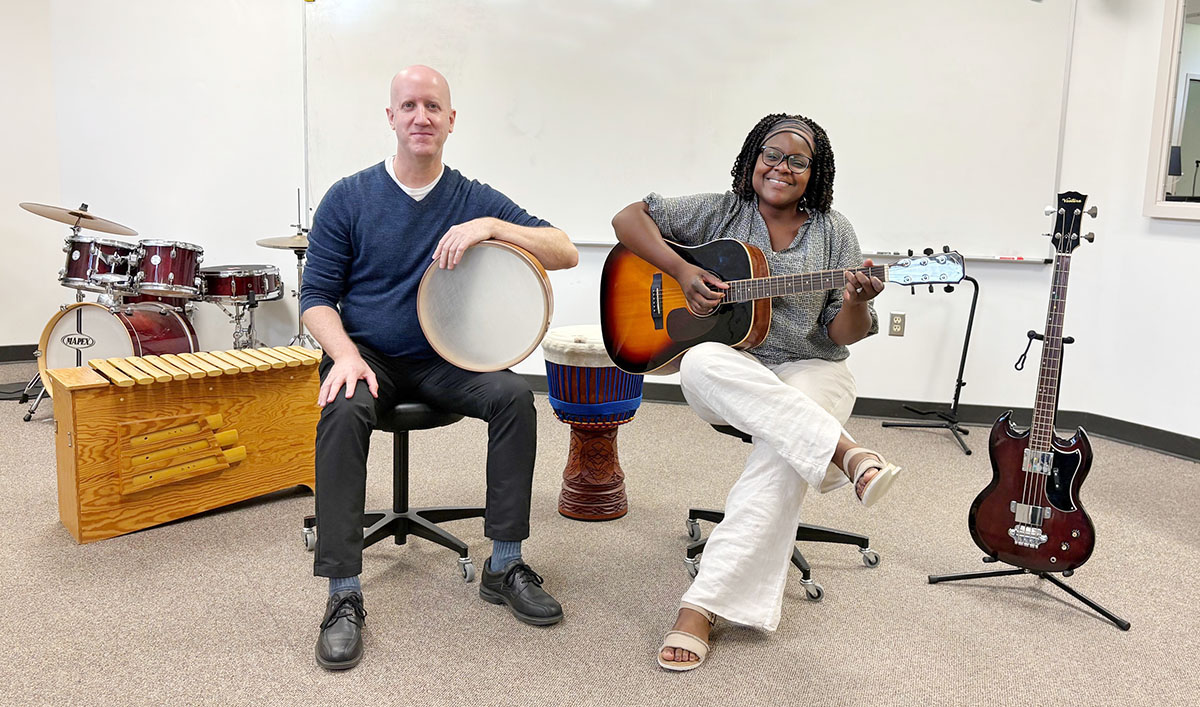
These are the findings of a deep-dive analysis of about a dozen veteran U.S. music therapists by a group of five co-authors, including William Matney, associate professor, and CharCarol Fisher, associate professor of the practice, both with the KU School of Music.
“Defining Music Therapy Musicianship: An Analysis of Music Therapists’ Clinical Work” was published May 29 in the Journal of Music Therapy.
Participating therapists submitted a video recording of a client session (average length 35 minutes) for initial analysis, after which they were interviewed by two of the researchers. The tapes were then analyzed, and the therapists’ work was categorized into 76 different musicianship “constructs,” according to factors that included intention, engagement and preparation. In the end, the authors identify “10 core components of music therapy musicianship,” as follows:
- Authenticity
- Musical knowledge
- Values and respects the client’s music
- Trust
- Service
- Openness
- Creativity
- Love of music
- Therapeutic alliance
- Trial and error.
Music therapy is a dialogue — not a lecture or concert, according to Matney. Clients can range, developmentally speaking, from babies in the neonatal intensive care unit to adults in hospice. In every case, therapists use their training — both musical and psychological — to address a range of domains, including but not limited to breaking down barriers to communication and eliciting emotional responses from clients in hopes that can help them to understand, accept and/or adapt to their challenges.
For instance, in regard to cognitive/academic skills, Matney said, just as you probably learned the alphabet with the help of a song, “Music therapists write songs for and with their clients to help them learn and remember things.” Music therapists, therefore, are facilitating the creation, composition, improvisation and reception of music in relation to their clients’ needs.
Because each client is obviously an individual, the authors write, “no two sessions sounded, looked, or felt the same” in their video analysis.
Yet the goal of every session, the authors write, is “musicking,” in which music is understood as an event, rather than a product.
“The concept of musicking is the process of engaging, creating, performing,” Fisher said. “But it's more than that. It is this relationship, this interaction, where it's not that performer-audience dynamic, but everybody is a participant in the process of making music together.”
This has implications for the training of future music therapists, the authors write. While university music students across the United States typically concentrate on learning and performing the canonical classical repertoire, the authors said their study supports those who want to make the training of future music therapists more broad-based and up-to-the-minute.
“Music therapy musicians are globalist musicians,” Matney said. “We need to be prepared in a large range of repertoire. So I can play a hymn for somebody, or I can play Metallica, or I can play Dexys Midnight Runners. I need, to some degree, to have the underpinning to play a range of musics on a range of instruments and even be flexible with how that music is presented.”
Even if a therapist isn’t a Taylor Swift or Beyonce fan, their client might be inspired by today’s top pop stars. Thus, Fisher said, “You need to be able to understand how to access the music and be as authentic to the music as possible.”